Most personal AI systems fail at the boundary between capture and memory.
The tempting move is to give the model all the notes, files, clips, transcripts, and fragments. That looks like intelligence because the system has more context. It is often just a larger surface area for stale assumptions.
The useful architecture separates capture from memory, memory from retrieval, retrieval from action, and action from feedback. Each boundary exists because agent memory can poison itself if every saved fragment becomes reusable context.
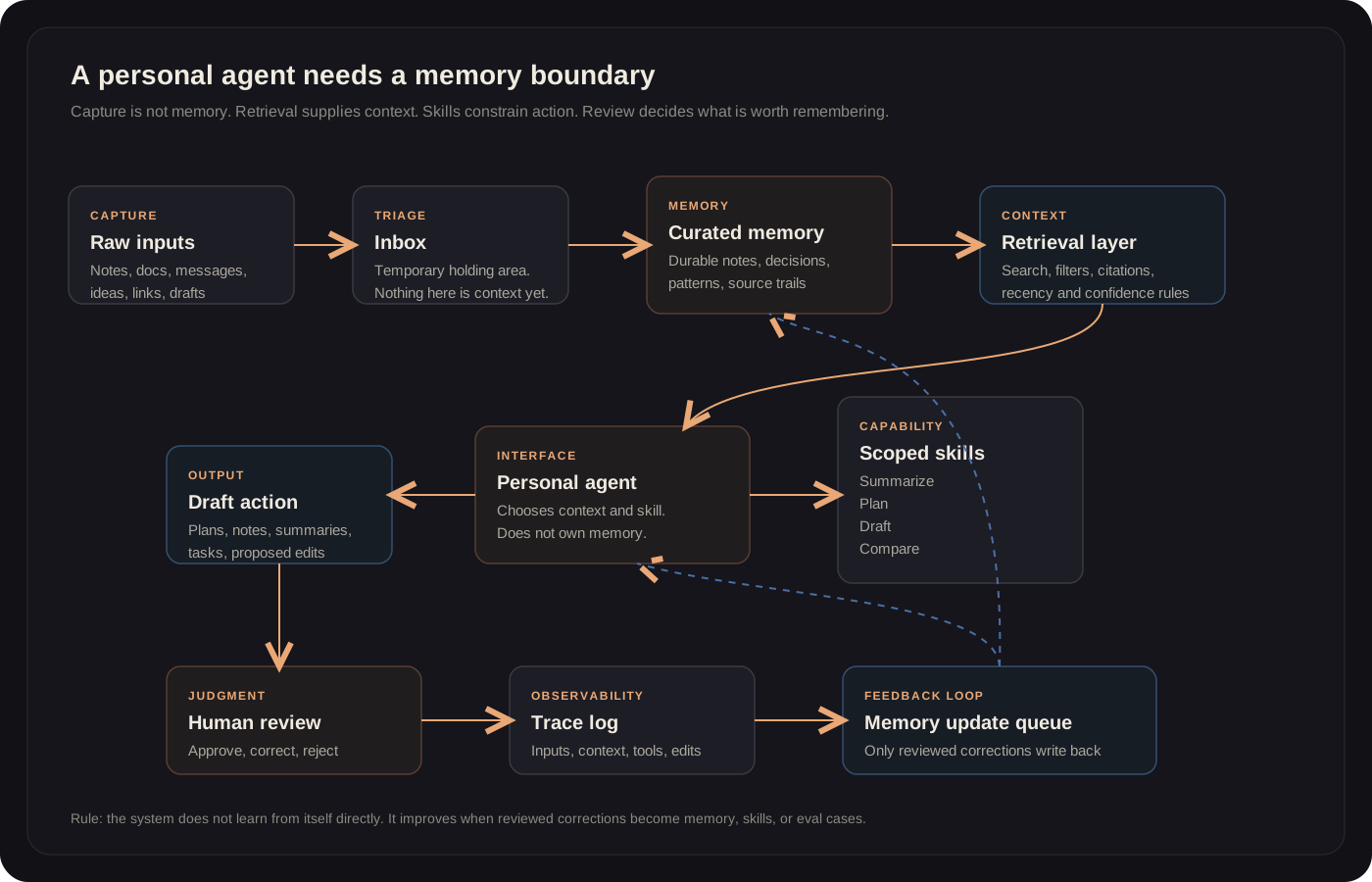
What this is
This is the pattern I would use for a personal agent memory system: raw capture, curated memory, retrieval, a personal agent, scoped skills, human review, trace logging, and a feedback loop.
The agent is not the memory system. The agent is the interface to it.
That distinction matters. A private archive is allowed to be messy because human thinking is messy. An agent that acts on messy memory is not allowed the same indulgence. It needs source trails, recency rules, skill boundaries, and a way to know when a note is a private scratchpad rather than a durable belief.
How it works
Raw inputs land in an inbox first: notes, links, meeting fragments, documents, ideas, half-written drafts. The inbox is not trusted. It is just capture.
Curated memory is different. A note gets promoted when it is worth reusing: a decision, a pattern, a preference, a project state, a source-backed claim, a reusable instruction. This is where most personal systems fail. They treat everything saved as equally retrievable. The agent then cannot tell the difference between "I thought this once" and "this is still true."
The retrieval layer sits between the vault and the agent. It does not simply fetch semantically similar chunks. It should filter by source, freshness, project, confidence, and use case. The retrieval question is not "what is related?" It is "what context is safe to use for this task?"
The personal agent uses that retrieved context and chooses from scoped skills: summarize, plan, draft, compare, extract, critique, prepare. Skills should be narrow enough that their outputs can be judged. A giant "do everything" agent is harder to improve because failure has no address.
The output is not final by default. It is a draft action: a plan, a note, a summary, a task list, a proposed edit. The human review step is where judgment enters the system.
The feedback loop
The impressive part is not that the system "learns from itself." It should not.
It improves when reviewed corrections become one of three things:
- Memory update: the vault changes because a fact, decision, preference, or source trail changed.
- Skill update: a recurring correction becomes part of a skill's instructions.
- Eval case: a failure becomes a small test case the system should pass next time.
That loop is the difference between an agent that feels clever once and a system that gets more useful over time.
The human review step is the gate. Without it, the system writes its own mistakes back into memory and becomes more confident in the wrong direction.
Inside the boxes
The diagram only works if each box has a job.
- Raw intake is not memory: how inputs are captured, tagged, summarized, and kept untrusted.
- Memory promotion is the product: how a fragment becomes reusable context.
- Retrieval is a judgment layer: why retrieval needs source, freshness, confidence, and permission filters.
- Skills are bounded capabilities: how to define a skill so failure has an address.
- Feedback loops need a place to land: how corrections become memory updates, skill changes, eval cases, or routing rules.
Build sequence
Start with capture and curation. If the vault is not separated from the inbox, retrieval will surface stale fragments and private scratch notes as if they were facts.
Then add retrieval with citations. Do not add action until the system can show what it used.
Then add one skill. Not five. A useful first skill is usually "turn this raw input into a project brief" or "prepare me for this meeting from these notes." The output should be easy to inspect.
Then add the trace log: input, retrieved sources, skill used, draft output, human edits. If you cannot replay what happened, you cannot improve it.
Only then add the feedback loop.
What I would not automate first
I would not let the agent send messages, update external systems, delete notes, or rewrite durable memory without review.
Those actions create trust faster than they create value. A personal system can feel magical while quietly corrupting the record. The first useful version should make better drafts and better recall, not autonomous decisions.
Failure modes
- The inbox becomes memory: every captured fragment is treated as reusable truth.
- Retrieval becomes vibes: the agent cites related notes instead of relevant notes.
- Skills become personality: a skill is just a tone preference, not a bounded capability.
- Corrections disappear: the human fixes the output, but the fix never becomes memory, a skill update, or an eval case.
- The agent gets agency before it gets accountability: it can act before anyone can inspect how it decided.
Architecture references
This pattern borrows from several current agent architecture ideas without adopting any one framework wholesale.
Anthropic's agent guidance makes a useful distinction between predefined workflows and agents that dynamically choose actions. A personal agent memory system should usually begin as workflow plus retrieval, not open-ended autonomy. OpenAI's Agents SDK emphasizes tools, handoffs, and tracing. LangGraph's framing of short-term and long-term memory is useful, as long as "memory" does not become a synonym for "everything saved." MCP matters because tools and context need interfaces you can reason about.